
# Packaging ERP Software: How to Reduce Material Wastage and Improve Production Efficiency
In a packaging manufacturing business, profitability is often decided by things that are easy to overlook.
A few extra sheets consumed during production, material purchased in excess, an incorrect job estimate, or a machine waiting because the required substrate is unavailable. Individually, these may seem like routine operational issues. Across multiple orders and production cycles, however, they can make a noticeable difference to the business.
The challenge is that material wastage rarely comes from one department alone. It can begin during estimation, increase during planning, appear on the production floor and remain unnoticed until someone reviews the final job cost.
For packaging manufacturers handling multiple orders, materials and production requirements, controlling these activities requires more than maintaining separate spreadsheets or relying on individual experience.
This is where packaging ERP software becomes useful. By connecting estimation, inventory, production planning and job-wise reporting, an ERP system gives management better visibility into where materials are being consumed and where improvements are needed.
Let's understand how this works in practice.
## Why Does Material Wastage Happen in Packaging Manufacturing?
Before discussing how ERP software helps, it is important to understand where wastage actually starts.
In packaging manufacturing, material consumption depends on several factors, including order specifications, substrate selection, machine settings, production quantities and quality requirements.
Some common reasons behind unnecessary material consumption include:
### 1. Incorrect Material Estimation
An inaccurate estimate can affect the entire production process.
If the quantity of paper, board, film, ink or other materials required for a job is calculated incorrectly, the business may purchase more material than necessary or face shortages during production.
Both situations create problems. Excess purchasing can increase inventory costs, while shortages can interrupt production and delay delivery.
### 2. Poor Production Planning
When multiple jobs are scheduled without considering machine capacity, material availability and production requirements, unnecessary changeovers and waiting periods can occur.
For example, a packaging plant handling several jobs with different substrate specifications may lose valuable production time if job sequencing is not planned properly.
### 3. Lack of Inventory Visibility
Many businesses maintain inventory records through spreadsheets or separate departmental systems.
Over time, differences can develop between recorded stock and actual physical stock. Materials may remain unused, get purchased again unnecessarily or become difficult to trace.
Without reliable inventory information, planning becomes more complicated.
### 4. Rework and Quality Issues
Incorrect specifications, inconsistent production settings and quality problems can result in rejected or reprinted material.
Apart from the material itself, rework also consumes machine time, labour and production capacity.
### 5. Delayed Production Information
If material consumption and job progress are recorded manually, management may not get accurate information when it is needed.
By the time the actual figures are reviewed, the opportunity to correct the problem may already have passed.
## How Does Packaging ERP Software Help Reduce Material Wastage?
An ERP system does not physically eliminate production waste. Its value lies in connecting business information, improving planning and making material consumption easier to monitor.
Here are five areas where it can make a practical difference.
### 1. More Accurate Job Estimation and Costing
Every packaging order has its own specifications, material requirements and production considerations.
A structured estimation process helps businesses calculate the expected material consumption and production cost before accepting an order.
With ERP-based estimation, relevant job specifications, material requirements and costing information can be maintained in a connected system.
This helps businesses:
- Prepare more consistent job estimates. - Account for material requirements before production. - Understand the expected cost of an order. - Compare estimated costs with actual job costs.
The objective is not simply to prepare quotations faster. It is to make sure the business understands the cost and requirements of a job before committing to it.
### 2. Better Inventory Management and Material Tracking
Inventory management plays an important role in controlling working capital.
Packaging manufacturers often deal with different types of materials, sizes, specifications and suppliers. Managing all of them without proper records can become difficult as order volumes increase.
A packaging ERP system can help maintain structured inventory information, record material movements and provide visibility into stock availability.
This allows businesses to:
- Check material availability before scheduling jobs. - Maintain more reliable stock records. - Identify slow-moving and excess inventory. - Plan purchases according to actual requirements. - Reduce unnecessary material procurement.
For example, if a production team needs a particular film or board specification, the team should be able to check its availability before committing to a production schedule.
Better information helps avoid last-minute purchasing and unnecessary stock accumulation.
### 3. Smarter Production Planning and Scheduling
Production efficiency is not just about running machines faster. It is also about reducing avoidable interruptions and making better use of available resources.
A connected production planning system helps businesses coordinate job requirements, machine availability and production schedules.
For packaging manufacturers, this becomes particularly useful when multiple orders are moving through different production stages.
A well-planned schedule can help:
- Reduce unnecessary machine changeovers. - Improve coordination between departments. - Identify production bottlenecks. - Balance machine workloads. - Track job progress more effectively.
For instance, if two jobs require similar material specifications and compatible machine settings, the production team may be able to plan them more efficiently.
Such decisions depend on actual production constraints, but having the necessary information in one place makes those decisions easier.
### 4. Monitoring Actual Material Consumption
One of the most important steps in controlling wastage is understanding how much material a job actually consumes.
There can be a difference between the quantity estimated during costing and the quantity used during production.
If this difference is not recorded, the business may continue repeating the same mistakes across future orders.
ERP-based job tracking can help businesses compare planned and actual material consumption.
This makes it easier to identify:
- Jobs with unusually high material consumption. - Repeated production wastage. - Differences between estimated and actual costs. - Departments or processes that need attention. - Opportunities to improve production practices.
Instead of relying entirely on assumptions, management can use job-wise information to investigate the reasons behind material losses.
### 5. Better Production Reporting and Management Visibility
Production information is useful only when it reaches the right people at the right time.
If managers have to collect information from different departments before understanding the status of production, decision-making becomes slower.
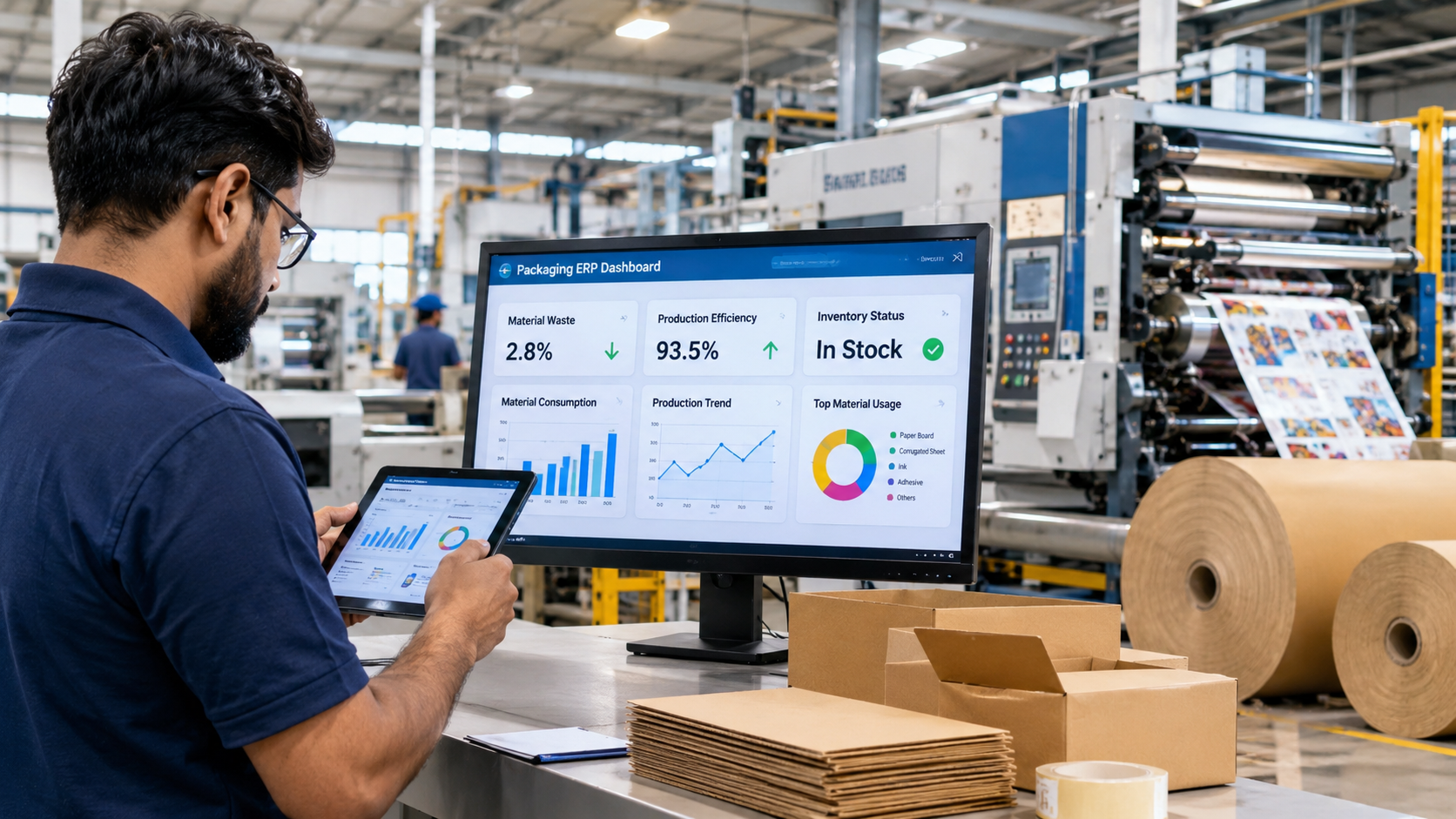
ERP and Business Intelligence (BI) dashboards can bring important operational information together.
Depending on the system and available data, management can review:
- Production status across jobs. - Inventory levels and material movements. - Estimated versus actual job costs. - Production delays and bottlenecks. - Operational and financial performance.
This helps business owners move from reactive decision-making towards more informed planning.
## A Practical Example: Where Does the Material Actually Go?
Consider a packaging manufacturer that receives an order for 50,000 printed packaging units.
Before production begins, the team estimates the required material quantity based on the job specifications and expected production requirements.
During production, however, additional material is consumed because of setup adjustments, rejected output and rework.
If the business only records the final production quantity, it may never understand why actual material consumption exceeded the estimate.
Now consider the same workflow with a connected ERP system.
The business can maintain the job specifications, planned material requirements, production records and actual consumption information together.
After completing the job, management can compare the estimated and actual figures.
If the difference is higher than expected, the team can investigate the reason.
Was the initial estimate incorrect? Did the machine require additional setup material? Was there a quality issue? Did production follow the approved specifications?
The ERP system does not answer every operational question automatically. However, it provides the information needed to ask the right questions and take corrective action.
That is how better production control begins.
## Why Packaging Manufacturers Need Industry-Specific ERP Software
Not every ERP system is designed around the requirements of printing and packaging businesses.
A general-purpose ERP may handle accounting, purchasing and basic inventory, but packaging manufacturing also involves specialised job specifications, material tracking, production scheduling, job costing and process-level reporting.
For example:
- Flexible packaging manufacturers may need to manage film, foil, cylinders and repeat-related costing. - Corrugated box manufacturers deal with flute specifications, board consumption, order tracking and production wastage. - Flexo and label manufacturers need better control over substrates, dies, production specifications and job costing.
An industry-specific ERP is designed to address these operational differences rather than forcing every manufacturing process into a generic workflow.
The right system should match the actual production process of the business, not simply offer a long list of software features.
## What Should You Look for in Packaging ERP Software?
Before selecting an ERP system, packaging manufacturers should evaluate their existing processes and identify the areas where they are losing control.
Some important capabilities to consider include:
1. **Job Estimation and Costing:** The ability to calculate material and production costs based on job specifications. 2. **Inventory Management:** Structured stock records and material availability tracking. 3. **Production Planning:** Scheduling based on job requirements and machine capacity. 4. **Job Cards and Production Tracking:** Visibility into job progress and production information. 5. **Wastage Monitoring:** The ability to record and review material consumption. 6. **BI and Management Reporting:** Access to meaningful production, inventory and costing information.
A good ERP implementation should also consider employee responsibilities, existing workflows and the quality of available data.
Software alone cannot correct an unclear production process. The process must first be understood, organised and then supported with the right technology.
## How Indus Analytics Helps Packaging Businesses Improve Operational Control
At Indus Analytics, our work focuses on the operational challenges of printing and packaging businesses.
We understand that every manufacturing plant has its own processes, production requirements and management challenges. Therefore, the first step should be identifying where the business is losing time, money or operational control.
Our technology solutions support different segments of the printing and packaging industry.
Depending on the manufacturing requirements, businesses can explore:
- **Indus Print ERP:** An integrated ERP platform for managing printing and packaging business operations. - **Gratude:** Rotogravure production software designed for flexible packaging converters. - **CoreEasy ERP:** An ERP solution built for corrugated box manufacturers, with support for flute tracking, production and order management. - **BI Dashboards:** Business intelligence tools that provide visibility into production, inventory, sales and costing information.
Our approach follows the PPA (Print Process Automation) Framework:
**Diagnose → Design → Connect → Enable → Measure & Improve**
The idea is simple: understand the existing process, identify operational gaps, implement the right system and continuously measure improvements.
Because successful automation is not about installing software and expecting everything to change overnight. It is about making the business more organised, measurable and easier to manage.
## Final Thoughts
Material wastage in packaging manufacturing is rarely caused by a single mistake. It is often the result of several small operational gaps across estimation, inventory, production planning and quality control.
Trying to solve each problem separately may provide temporary relief, but long-term improvement requires better coordination between departments and reliable operational information.
Packaging ERP software helps businesses build that connection.
When material requirements are estimated properly, inventory is monitored consistently, production is planned carefully and actual consumption is reviewed, management gets a better opportunity to control costs and improve efficiency.
The first step is not necessarily buying new software. It is understanding where the current process is falling short.
**Want to identify where your packaging business is losing material, time and money?**
Connect with Indus Analytics to understand your operational gaps and explore a practical automation roadmap for your business.
**Start with a 30-Day Automation Assessment and discover what your business can improve first.**
[Explore Indus Analytics](https://www.indusanalytics.biz/) | [Explore Our ERP Solutions](https://www.indusanalytics.biz/products) | [Contact Our Team](https://www.indusanalytics.biz/contact)
## Frequently Asked Questions
### 1. What is packaging ERP software?
Packaging ERP software is a business management system designed to connect key manufacturing activities such as job estimation, inventory, production planning, job tracking, costing and reporting.
### 2. How can ERP software reduce material wastage in packaging?
ERP software helps businesses monitor material requirements, improve inventory visibility, compare estimated and actual consumption, and identify recurring production inefficiencies. This information helps teams take corrective action.
### 3. Can packaging ERP software improve production efficiency?
Yes. By connecting production planning, job scheduling, material availability and production tracking, ERP software can help reduce avoidable delays and improve coordination between departments.
### 4. Is industry-specific ERP better for packaging manufacturers?
An industry-specific ERP can be more suitable because it is designed around the actual requirements of packaging production, including specialised materials, job specifications, costing and manufacturing workflows.
### 5. How do I choose the right ERP for my packaging business?
Start by identifying your manufacturing segment, current operational challenges, material tracking requirements, costing process and production workflow. Then evaluate ERP solutions based on how well they support those requirements.